Get Free Ebook Photodetectors: Devices, Circuits and Applications, by Silvano Donati
If you really want actually obtain the book Photodetectors: Devices, Circuits And Applications, By Silvano Donati to refer currently, you need to follow this web page constantly. Why? Keep in mind that you require the Photodetectors: Devices, Circuits And Applications, By Silvano Donati resource that will provide you right expectation, don't you? By seeing this web site, you have actually started to make new deal to consistently be updated. It is the first thing you could start to get all gain from remaining in a web site with this Photodetectors: Devices, Circuits And Applications, By Silvano Donati and also various other compilations.
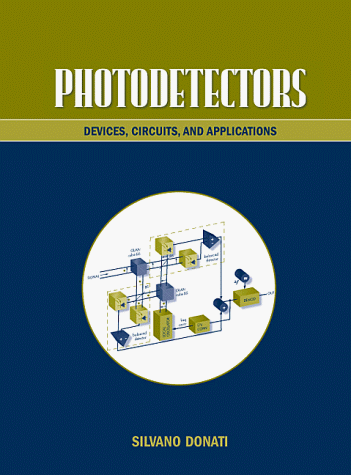
Photodetectors: Devices, Circuits and Applications, by Silvano Donati

Get Free Ebook Photodetectors: Devices, Circuits and Applications, by Silvano Donati
Photodetectors: Devices, Circuits And Applications, By Silvano Donati. Offer us 5 minutes as well as we will reveal you the very best book to read today. This is it, the Photodetectors: Devices, Circuits And Applications, By Silvano Donati that will certainly be your best option for far better reading book. Your 5 times will not spend thrown away by reading this site. You can take the book as a source to make far better idea. Referring the books Photodetectors: Devices, Circuits And Applications, By Silvano Donati that can be positioned with your needs is at some time hard. Yet right here, this is so very easy. You can find the best point of book Photodetectors: Devices, Circuits And Applications, By Silvano Donati that you can read.
Sometimes, checking out Photodetectors: Devices, Circuits And Applications, By Silvano Donati is extremely monotonous and also it will take long time starting from obtaining guide as well as start checking out. Nevertheless, in modern period, you could take the creating innovation by utilizing the web. By web, you could visit this web page and begin to look for guide Photodetectors: Devices, Circuits And Applications, By Silvano Donati that is needed. Wondering this Photodetectors: Devices, Circuits And Applications, By Silvano Donati is the one that you need, you could go for downloading. Have you recognized how to get it?
After downloading and install the soft data of this Photodetectors: Devices, Circuits And Applications, By Silvano Donati, you can start to review it. Yeah, this is so enjoyable while someone must review by taking their large publications; you remain in your new means by just manage your gadget. And even you are operating in the workplace; you can still use the computer to read Photodetectors: Devices, Circuits And Applications, By Silvano Donati completely. Certainly, it will certainly not obligate you to take lots of pages. Simply page by page relying on the moment that you have to check out Photodetectors: Devices, Circuits And Applications, By Silvano Donati
After knowing this quite simple way to review and also get this Photodetectors: Devices, Circuits And Applications, By Silvano Donati, why do not you inform to others regarding this way? You can inform others to visit this site and go for browsing them preferred publications Photodetectors: Devices, Circuits And Applications, By Silvano Donati As recognized, below are bunches of lists that supply numerous kinds of publications to gather. Merely prepare few time as well as internet connections to get guides. You can truly delight in the life by reading Photodetectors: Devices, Circuits And Applications, By Silvano Donati in a quite simple way.
2033G-2 The complete guide to photodetection Today's optoelectronic devices rely on accurate detection of light sources across the spectrum. This comprehensive guide surveys single-point devices and their image counterparts covering the range from UV to far IR. Basic operations, performance parameters, and special features are presented in the context of application circuits. Special attention is given to issues of sensitivity and noise limits. The devices surveyed include: * Photomultipliers * Semiconductors, photodiodes, avalanche devices, and phototransistors * Thermal devices and solar cells * Image detectors and CCDs Concluding chapters deal with coherent detection and advanced techniques, while appendices offer convenient reference materials for key principles. Photodetectors: Devices, Circuits, and Applications is a useful reference for working engineers and an ideal sourcebook for university-level courses.
- Sales Rank: #2564573 in Books
- Published on: 1999-11-13
- Original language: English
- Number of items: 1
- Dimensions: 9.10" h x 1.10" w x 6.90" l, 1.57 pounds
- Binding: Paperback
- 432 pages
From the Inside Flap
Preface
This book is an outgrowth of the lecture notes of a two-semester course in optoelectronics, which I started to give in 1976 at the University of Pavia. The lecture was given to electronic engineers in their final year of the MS curriculum. Through the years, I have rewritten the text several times, enlarged the scope, added data useful for design, and included new results coming from both by own research and new findings by others. Thus, the present book has become more similar to a treatise than to the original lecture book. I have tried to use a modern teaching approach, starting with simple ideas and developing a wide range of topics, so that this book can serve as a textbook in basic photoelectronics and also be profitable to the designer engineer looking for practical hints and solutions. Mathematical derivations are kept to a minimum, and readers interested in applications may skip them and go directly to the results, which I have tried to make useful by comments and examples. Complementary information and advanced considerations appear in reduced character size and may be skipped in a first reading. In the appendixes, I have collected some material either necessary as an introduction or of practical relevance for applications.
In the paradigm of optoelectronics, light is generated by a source - frequently a laser - which propagates in a medium, or interacts with it, and then comes to a detector where the desired information is converted back to an electrical signal. In the signal-to-noise budget, increasing the laser power by a factor of K is equivalent to reducing the detector noise by K - a simple statement whose importance is sometimes understated, but one that should always be kept in mind in order to optimize system performances of the photodetector.
Photodetectors are the forerunners of any frontier in optoelectronics. When an unusual spectral range or a new frequency band is explored, photodetectors are first to establish a tool for handling the optical signal. Then, optical components and laser sources follow. Thus, the excitement of the discovery comes more frequently with photodetectors than with the other optoelectronic devices. Figures P-1 through P-4, on the following pages, show just a sampling of the big achievements of photodetectors.
This book covers the very basic background of photodetection that should be mastered by any scientist or designer active in modern optoelectronics. To give an order-of-magnitude idea, in the optoelectronics-oriented curriculum offered at our engineering facility, one course is devoted to lasers, one to photodetection, one to fiberoptics communication, and one to electrooptics instrumentation.
This book is structured as follows. All types of photodetectors of practical importance covering the spectral range from UV to far IR are considered, first treating singe-point devices and then their image counterparts. For each photodetector, we begin by understanding the principle of operation. We then discuss parameters of performance, basic characteristics, special features, and application circuits with schematic details and design hints. Finally, we end up analyzing in special detail noise, which is the ultimate limit of sensitivity performance - the goal to be approached in any well-designed application.
Commenting on the list of contents, we start with the photoemissive (i.e., vacuum) devices, historically the first and presently in a technical decline, but still unparalleled in allowing the powerful single-photon counting regime actually exploited in several scientific applications. After a chapter on photocathodes and vacuum phototubes, in Chapter 3 we consider the system aspects of photodetection, stressing the importance of an internal gain mechanism in photodetectors, and also clarifying the regimes of detection as well as introducing the figures of merit.
Chapter 4 is fairly long and is devoted to photomultipliers because of their importance in a variety of applications. We present the basic theory, analyze the response in time and frequency domain, and discuss a number of applications.
Chapter 5 deals with semiconductor photodetectors and related devices, including the family of photodiodes, avalanche devices, phototransistors and photoconductors, and solar cells. In addition to physical aspects and electrical characteristics, we treat the application circuits, elucidating the design of front-end circuits and discussing their performances in a number of well-established applications, from instrumentation to large-bandwidth communication.
Infrared techniques and thermal detectors for non-contact temperature measurements and thermal-image pickup are treated in Chapters 6 and 7.
Chapter 8 is devoted to coherent detection and advanced techniques in photodetection, covering topics not usually found in textbooks and demonstrating how photodetection is far from being a completely explored field.
Chapter 9 treats image-sensing devices, including vidicon tubes, intensified image-tubes, and the CCD family. Finally, a series of appendixes is added to complement the text and deal with basic topics such as radiance invariance, eye sensitivity and color description, thermal and quantum noise, details of calculations omitted in the text, and more.
In regards to system aspects, the sensitivity/bandwidth tradeoff and the quantum/thermal regime of detection considered in Chapter 3 might also have been placed at the beginning of the book or merged in Chapter 8, but in my teaching experience I find they are best discussed soon after the very first description of detectors and their electrical parameters. Also, I have included a short chapter on solar cells because these devices are closely related to photodiodes and share the same technological problems and development issues (besides belonging to the optoelectronic engineer in systems deployment).
Thus, this book offers a rather wide coverage of photodetectors from the point of view of devices, circuits, and applications. I have tried to make each chapter self-contained and readable in itself so that it can be useful as a reference for anyone interested in solving his/her particular photodetection problem.
In my experience from the Italian edition, the text can be used for a two-semester course as a whole, or for a one-semester course with several different choices of arguments or stress upon devices, circuits, or system aspects. I have also used it for a series of seminars to Ph.D. students in an advanced course on photodetection and noise. I think that this book will also be a useful reference and aid for technical people and professionals involved in the design of photodetection systems. Engineers and physicists may use it as a guide in choosing the best solution and in evaluating the achievable performances in a photodetection problem. Designers should find it useful because of the abundant reference data on actual photodetectors, as well as for the practical circuits discussed.
For a full understanding of the technical content, this book requires as a prerequisite the basic courses in electronic devices and circuits, and the very fundamentals of semiconductors and noise. In regards to semiconductors, an excellent introduction is provided by Bhattacharya's book Semiconductor Optoelectronic Devices (Prentice Hall). Of course, many topics and ideas can be gathered from the material presented in this book as well, though with a more modest background.
In closing, I wish to thank the numerous researchers and students of mine for their help in collecting the text of my lectures and in suggesting corrections to the earlier versions. Among all, I am pleased to acknowledge my former Ph.D. student T. Tambosso, who collected and edited the first version with great care and suggested several major improvements to the content, incorporated since the first Italian edition.
I also wish to thank professor Joe C. Campbell of the University of Texas and professor Sergio Cova of the Polytechnic University of Milano for their encouragement and suggestions.
In my scientific career, I have found photodetection to be a very exciting and rewarding field of study. If I can convey to the reader the same enthusiasm and satisfaction, I will be amply rewarded for my efforts in writing this book. So, I dedicate this book to the brilliant young students who will become the scientists of tomorrow.Silvano Donati
Pavia, Italy
email: donati@ipvsm6.unipv.it
June 1999
Figure P-1
The SuperKamiokande facility employs 11,200 giant PMTs (photomultipliers, see Chapter 4) valued at about 80 million US$, and paving the walls of a 40-meter diameter tank of water that probes the most elusive nuclear particles-neutrinos (courtesy of ICRR, University of Tokyo).
Figure P-2
Aboard the Sky Telescope, a 5000 x 5000 pixel CCD (charge coupled device, see Chapter 9) has provided this 10-day integration picture of deep sky (Hubble Deep Field Survey). Faintest spots are 30th magnitude galaxies, estimated to be 8 billion light-years away (courtesty of R. Williams and the HDF Team ST Scl, and NASA).
Figure P-3
Infrared t
From the Back Cover
2033G-2
The complete guide to photodetection
Today's optoelectronic devices rely on accurate detection of light sources across the spectrum. This comprehensive guide surveys single-point devices and their image counterparts covering the range from UV to far IR. Basic operations, performance parameters, and special features are presented in the context of application circuits. Special attention is given to issues of sensitivity and noise limits. The devices surveyed include:
- Photomultipliers
- Semiconductors, photodiodes, avalanche devices, and phototransistors
- Thermal devices and solar cells
- Image detectors and CCDs
Concluding chapters deal with coherent detection and advanced techniques, while appendices offer convenient reference materials for key principles. Photodetectors: Devices, Circuits, and Applications is a useful reference for working engineers and an ideal sourcebook for university-level courses.
About the Author
SILVANO DONATI has been a full professor of Optoelectronics at the University of Pavia, Italy, since 1980. A graduate of the University of Milan, Italy, he has more than 30 years' experience with photodetectors and their applications in electro-optical instrumentation and fiberoptic communications. His special interests include the time and frequency responses of PMTs and APDs, performance of image-CCDs, and such advanced photodetection techniques as squeezed-state and injection detection. He has authored more than 160 papers and holds 10 patents. Dr. Donati is the founder and current chair of the IEEE-LEOS Italy chapter and belongs to IEEE (senior member), AEI (meritorious member), OSA, SPIE, and IEMS.
Most helpful customer reviews
9 of 9 people found the following review helpful.
Deep and wide
By Philip Hobbs
Photodetection is a surprisingly deep subject. Quantum photodetectors are probably the best transducers of anything in any field--one photon gets you one electron, over an enormous range of irradiance. Despite this apparent simplicity, intelligent design with photodetectors requires a deep knowledge of how they work, and what the tradeoffs in using them are.
Silvano Donati's _Photodetectors_ is a very good book, connecting much of the fundamental physics with operational specifications. Having these connections makes us more confident and more accurate in making design choices and photon budgets, leading to better instruments.
The language is clear for the most part, and the examples are helpful and come when needed. There are a few places where it looks a bit like a bunch of papers strung together, but those are mostly in the appendices, e.g. the derivation of the noise of avalanche photodiodes. Also, the discussions of ancillary subjects such as front end amplifiers are not quite as good as those on the primary subject of photodetectors.
These are minor objections, and _Photodetectors_ will repay your close reading if you have instruments to design. It has an honorable place on my bookshelf.
Photodetectors: Devices, Circuits and Applications, by Silvano Donati PDF
Photodetectors: Devices, Circuits and Applications, by Silvano Donati EPub
Photodetectors: Devices, Circuits and Applications, by Silvano Donati Doc
Photodetectors: Devices, Circuits and Applications, by Silvano Donati iBooks
Photodetectors: Devices, Circuits and Applications, by Silvano Donati rtf
Photodetectors: Devices, Circuits and Applications, by Silvano Donati Mobipocket
Photodetectors: Devices, Circuits and Applications, by Silvano Donati Kindle
0 komentar:
Posting Komentar